Background

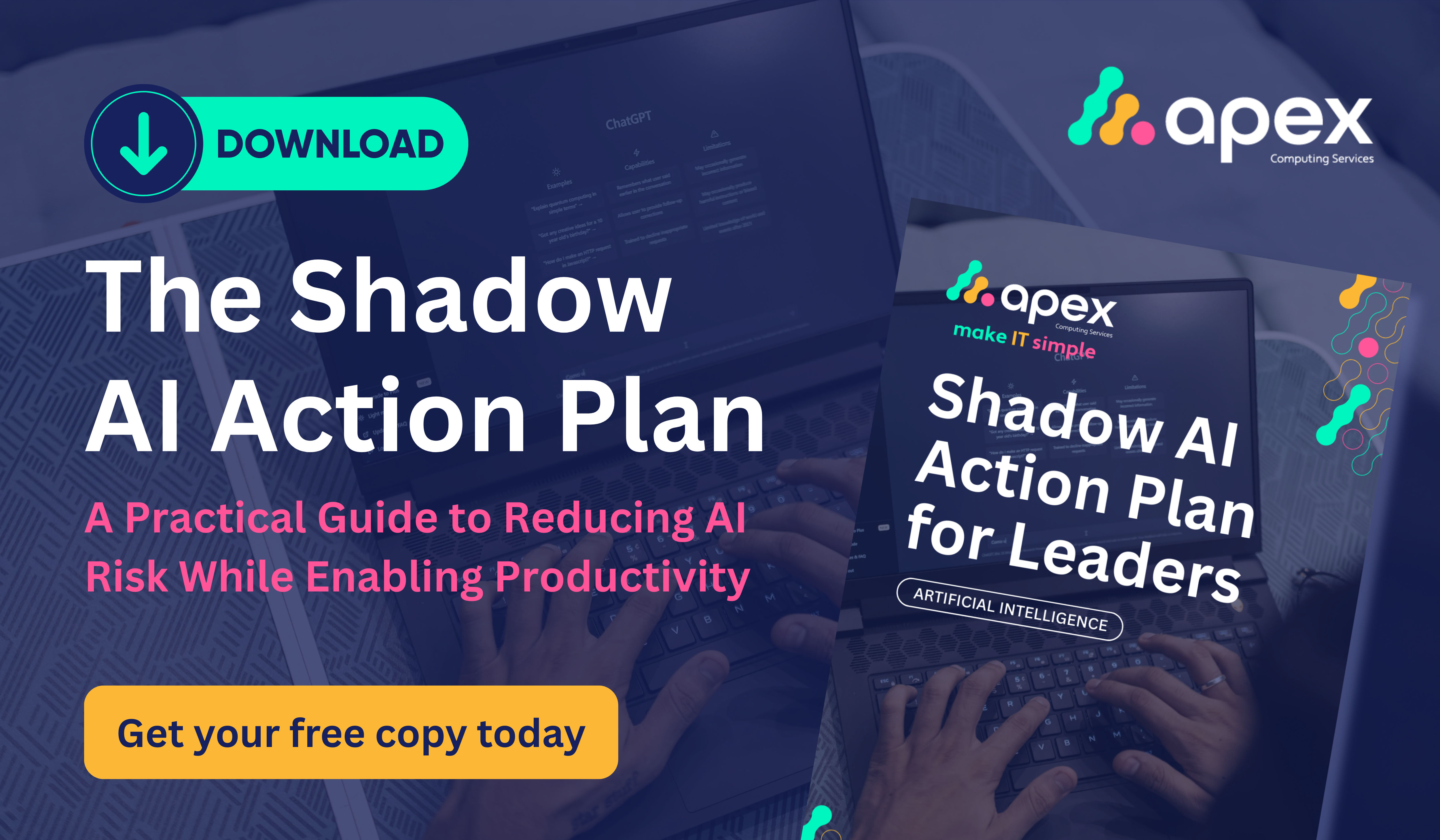
The Shadow AI Action Plan for Leaders

Free Download

AI is Already Part of Everyday Work...and that's a good thing when it's managed

Employees are using AI to draft emails, summarise meetings, analyse data, and generate content - often without formal guidance and oversight. This is known as Shadow AI: the use of AI tools that have not been formally approved, governed, or monitored by the organisation.


Shadow AI is rarely driven by bad intent. In most cases, it's a natural response to increasing workload pressure and the accessibility of public AI tools. The challenge for organisations is clear: How do you enable the benefits of AI without introducing uncontrolled risk?


This Action Plan provides a structured approach to reducing Shadow AI exposure while supporting safe, production adoption.

FREE Guide

Download your FREE Shadow AI Action Plan Here


Inside you'll find clear next steps you can start today:

Check

How to run a quick Shadow AI risk review
Check
A short, business-ready approach for "safe AI use"
Check
How to provide approved, secure AI tools and build staff confidence
Check
Lightweight governance and monitoring that enables - not blocks - innovation
Shadow AI Risk Plan Download
Trusted by Businesses Across All Sectors

What Is Shadow AI?

Shadow AI refers to any AI usage that occurs outside of approved organisational tools, policies, or governance.

Common examples include:

•  Employees using public AI tools or free accounts to write client emails

•  Teams uploading documents into unapproved platforms

•  Staff using personal accounts to access AI assistants

•  Departments adopting AI tools independently without IT visibility

The risk isn't AI itself - it's uncontrolled use without guardrails.

Why Blocking AI Isn't The Answer

A common first reaction is to block public AI tools entirely. While this may reduce surface-level exposure, it rarely solves the underlying issues, often leading to:

•  Workarounds using personal devices or accounts

•  Reduced transparency and openness

•  AI usage becoming harder to detect

•  Productivity frustrations across teams

The safer approach is:

✔ Visibility

✔ Policy

✔ Approved tools

 Education

✔ Governance

Shadow AI is best addressed through enablement, not suppression.

What Good Looks Like

When Shadow AI is addressed effectively, organisations achieve:
threat-detection (2)

Visibility into AI usage

maintenance (2)

Reduced reliance on public tools

teaching (3)

Clear staff confidence and guidance

24-hours (2)

Secure productivity improvements

1-Dec-18-2025-09-38-15-3375-AM

Lower operational and compliance risk

Untitled design (58)

AI becomes a business advantage - not an unmanaged risk

The 9-Step Shadow AI Action Plan

The first step is recognising that AI adoption is not a future event - it's already occurring across most organisations.


Leaders should assume:


•  Employees are experimenting with AI

•  Usage is uneven across departments

•  Some may involve sensitive data

•  Most people are unsure what is "allowed"


The goal is to bring AI into the open.

Before introducing restrictions or policies, begin with open discussions.


Ask teams:


•  Are you using AI tools today?

•  What tasks are you using them for?

•  Where are you unsure what's safe?

•  What would help you use AI responsibly?


These conversations build trust and provide visibility. Shadow AI is rarely a people problem - it's a clarity problem.

You cannot manage what you cannot see. A simple Shadow AI risk review should focus on:


•  What AI tools are being used

•  What types of data may be shared

•  Whether approved alternatives exist

•  Whether staff understand safe usage


Many organisations begin with a short internal assessment or quiz to establish a baseline. The outcome? A clearer picture of urgency and exposure.


Check your Shadow AI Risk Score with our quick quiz here.

Organisations need clear boundaries, not lengthy documents.


A practical AI usage policy should answer:


•  What data should never be entered into AI tools? (Client data, financial information, employee records)

•  Which tools are approved for business use?

•  When is human review required?

•  Who owns AI governance internally?


Policies should be short, clear, and accessible.

Shadow AI thrives when employees have no safe option. If teams are blocked from AI tools without an alternative, usage will simply move underground.


Secure, business-grade AI tools (such as Microsoft Copilot) provide:


•  Data protection within your environment

•  Permission-based access

•  Compliance alignment

•  Integration into existing workflows


The goal is to enable productivity safely, not remove capability.

Policies alone are not enough. Staff need real-world understanding.


Effective education includes:


•  What AI is good for (and what it isn't)

•  What information is safe to use

•  Examples of approved use cases

•  How to ask better questions (prompting)

•  When to escalate uncertainty


Education reduces risk more effectively than enforcement.

Governance doesn't need to be heavy.


A proportionate approach includes:


•  Approved tools list

•  Light-touch review for new AI adoption

•  Department champions and owners

•  Periodic usage check-ins

•  Clear escalation routes


Good governance supports AI progress rather than blocking it.

The safest way to adopt AI is to start with common, low-risk productivity wins:


•  Summarising internal documents

•  Drafting non-sensitive communications

•  Meeting notes and action tracking

•  Internal reporting support

•  knowledge base creation


Early wins build confidence and create momentum.

AI evolves quickly. Shadow AI risk is not a one-time issue.


Leaders should review:


•  How AI usage is changing

•  Whether staff feel supported

•  Whether policies remain clear

•  Whether new tools are emerging


Treat AI as an ongoing capability, not a one-off project.

Your Next Steps

When Shadow AI is addressed effectively, organisations achieve:
threat-detection (2)

Visibility into AI usage

maintenance (2)

Reduced reliance on public tools

teaching (3)

Clear staff confidence and guidance

24-hours (2)

Secure productivity improvements

1-Dec-18-2025-09-38-15-3375-AM

Lower operational and compliance risk

Untitled design (58)

AI becomes a business advantage - not an unmanaged risk

Quiz

Is Shadow aI Already in Your Business?


AI is already being used in most organisations - often without visibility or guidance. Our quick Shadow AI Risk Checker helps you understand where unmanaged AI usage may exist, what level of risk it creates, and what practical next steps to take.

 

Take the Shadow AI Risk Checker Quiz now.

Shadow AI Risk Checker Quiz
Trusted by Businesses Across All Sectors
1. Apex Winning Award for IT Support - Manchesters MSP

Build Your AI and Automation Roadmap with Apex

Whether you're starting with one team or planning a wider rollout, Apex can help you turn these use cases into secure, measurable improvements.

Manchester Office

45 Spring Gardens, Manchester, M2 2BG

MediaCity Office

Laser House, Media Village, Waterfront Quay, Salford Quays, M50 3XW